
Deer-Shaped Reliquary and Black-Lacquer Cover
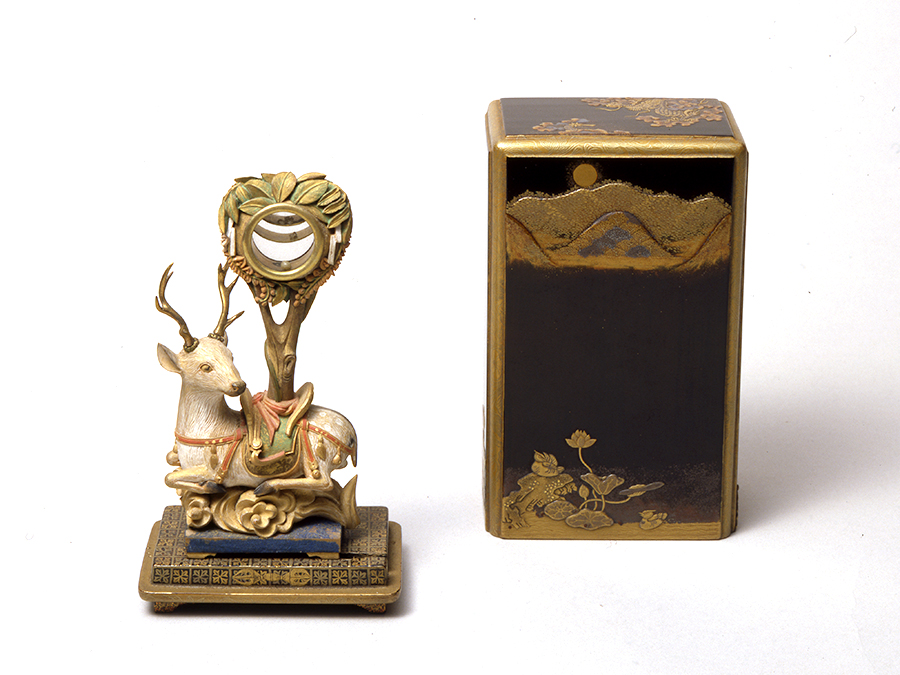
This wooden carving of a deer seated atop a cloud is typical of the historical intermingling of Shinto and Buddhism. The white deer, saddle, and sacred sakaki tree with a mirror in its branches are images strongly associated with Takemikazuchi no Mikoto, the primary deity of Kasugataisha Shrine. But despite this Shinto imagery, the carving has a distinctly Buddhist purpose.
The space inside the mirror holds relics venerated as the sacred remains of Shakyamuni, the historical Buddha. The reliquary’s lacquered cover also has many Buddhist motifs: Lotuses in different stages of bloom encircle the bottom, and one side bears an image of Vulture Peak, a mountain where Shakyamuni is said to have preached. On the reverse side is Mt. Mikasa, the sacred mountain to the east of Kasugataisha.
Shinto and Buddhist Imagery Combined
Buddhism reached Japan by the mid-sixth century via China and the Korean Peninsula. By that time, rituals centered around local kami deities had already been performed for centuries, and Buddhism was gradually incorporated into existing Shinto practice. Through this process of integration, Shinto and Buddhist deities eventually came to be seen as different forms of the same divine being. For example, both Shakyamuni, the historical Buddha, and Kannon, the bodhisattva of compassion, have been worshipped as Buddhist forms of Takemikazuchi no Mikoto.
This reliquary belonged to a Buddhist monk from nearby Kōfukuji Temple who donated it to Wakamiya Shrine in 1652. His act of donation also reflects the intertwined relationship of Shinto and Buddhism.

この英語解説文は観光庁の地域観光資源の多言語解説整備支援事業で作成しました。